Pages

Labels

12th anniversary 21st Amendment Monk's Blood Abbaye De Saint Bon Chien abhyasa abuse abyss active vs. passive poses acute pain agility agitated depression ahimsa Al-Aksir alasya ale alesmith alignment Allagash anatomy Anchor Brewing Anchor Brewing Company anchor steam Anchor Steam Brewing and moderation Andrea Gilats Angel's Share anger ankle circles ankle injuries ankle joint ankle problems ankle sprains anti-aging solution anxiety aparigraha appetite arm pain arm strength arms arthralgia arthritis arthritis (menopause) arthritis of shoulder joint atrial fibrillation avery avery maharaja award winning beer store ayurveda B.K. Bose baba back care back extensor muscles back pain balance Ballast Point baltic thunder bandhas bandwagon of healthy eating baroreceptors basque cider Baxter Baxter Bell bay area beer beer beer advocate beer castro beer club beer club san francisco beer list Beer of the Month beer of the month club beer pong beer shop san francisco beer store Belgian beer belgian beer glasses belgian beer san francisco Belgium. Japanese best beer store in the world BFM Bhagavad Gita Bhramari Bikram Choudhury biological clock Birra Troll Birrifio bitches brew Bittersweet Lenny black butte black lager blood lactate blood pressure body image bone strength Bonnie Maeda bottle bag bourbon Brad Gibson brain strength Brasserie Caracole breath breath practices Brettanomyces Beer Brewing Bridge pose Bridget Frederick Bruery Coton Bruery Mischief Bruery Saison De Lente bruising Brussels Bruton beer bursitis bypass surgery California beer Callifornia beer caloric restriction Cantillon cantillon san francisco Carol Krucoff cascade apricot cascade sang rouge cask strength sake Castro Cat pose Cat-Cow pose cataracts central nervous system cervical nerves Chair Cat pose Chair Downward-Facing Dog pose Chair Purvottansana chair yoga chair yoga sequence challenging pose charlie papazian chatoe rogue cheese Child's pose children Chimay chimay san francisco chocolate indulgence chondromalacia christmas beer chronic illness chronic inflammation chronic pain chronic stress cognitive decline cognitive health collapsed lung commenting comments community community yoga compassion compression of joints connective tissue conscious relaxation contacting writers contentment cortisol counter-poses Cow pose craft beer craft beer san francisco craft beer store craft brew creaky knees Cucapa Barley wine Cuvee de Tomme Cuvee des Champions Damnation dave hauslein david hausein David Hauslein Dayna Macy De Dolle De Proef De Ranke Dead Guy Ale Decadence Pomegranite Saison Decadent Evil degenerative disc disease dementia dental disease depression Depuceleuse san francisco DFH Faithful Ale DFH Twenty dharana dhyana dhyanam diabetes diet digestion digestive disorders digestive system dogfish head Dogfish Head Theobroma Dolphin pose dominus vibiscum doshas double ipa Downward-Facing Dog pose Downward-Facing Dog pose (variations) drake's denogginizer Drie Fontinen duck feet Eagle pose Easy Inverted Pose eating habits eating healthy Einbecker El Camino (un) real emotional wellbeing endorphins endurance training enteric brain equanimity eric's ale European Society of Cardiology exercise extensor muscles eye floaters eye problems facebook beer Fantome fatigue feet felt real happiness fifty fifty brewing company Firestone Walker first growth first trimester fizzy yoga Flanders flat feet Flemish Primitive flemish sour ale flexibility Food pyramid guide forehead skin forward bends fred echardt front body frozen shoulder full sail topsail fun gait Gandhi ganglion cysts Garudasana genetics Georg Feuerstein George Gale ginjo Gonzo goose island goose island san francisco Goouden Carolus gouden carolus Grand Cru greed grief grow your own Gueuze gueuze girardin Haandbryggeriet hakutsuru Halasana (supported) hands Handstand Hanssens lambic happiness hard cider head position head rush headaches health care professionals healthy aging healthy eating Healthy Eating Ideas healthy spirits healthy spirits Mikkeller 1000 IBU healthy spirits san francisco healthy spirits. Deschutes Jubel Ale 2010 healthy spirits. san francisco healthy spirits. san francisco beer healthy spriits healthy style of eating heart problems Hedonist Beer Jive herbs hernias high blood pressure himsa Hinduism hip arthritis hip dysplasia hip replacements history of yoga Hitachino Nest Hitachino XH hoarding home brew home practice home yoga practice hop wallop Howe Sound Hugh Malone hummus hypertension hypotension ida immune system inflammation inguinal hernias injuries insomnia Inverted Lake pose Irritable Bowel Syndrome Jalandara Bandha Japanese beer jatharagni jay hinman jizake John John joint health joint pain joint replacement joints Jolly Pumpkin Jon Kabat-Zinn Judith Lasater kampai karma yoga karuna Kausthub Desikachar kidney kleshas knee alignment knee joint knee pain knee replacement Koningshoeven Krishnamacharya Krishnmacharya kundalini lactic acid lager Lambic large women leg cramps leg length discrepancy (LLD) Legs Up the Wall pose life coaching Life Coaching Executives Life coaching problems ligaments lips of faith longevity Lost Abbey Lost Abbey Brewing Company low back low back pain low blood pressure Luciernaga Lucifer lying male hormones male menopause malnutrition Man Bites Downward-Facing Dog marijuana marin brewing barrel aged old dipsea massage medical advice medical conditions (informing teacher of) medical conditions (yoga for) meditation Melina Meza Melitta Rorty men menopause mental health Mephistopholes micro brew micro-brew middle-eastern Midnight Sessions Lager Midnight sun brewing midnight sun hop dog midnight sun san francisco migraines Mikkeller Mikkeller Beer Geek Breakfast Mikkeller Black Mikkeller chipotle porter mind-body connection mindful yoga mindfulness mini office yoga sequence mini yoga practices miracle mission statement mood Morton's Neuroma motivation Mountain pose Multiple Sclerosis Muriel Zimmerman music nadis napa smith nate breed neck anatomy neck pain neuroma neuropsychiatric disorders new arrivals new belgium new releases nigori Nina Zolotow Niroga Institute noble pils nocturnal leg cramps Nogne-O non-hoarding non-violence Norwegian beer nutrient-dense foods oak aged oak aged ale oatmeal stout Odonata Rorie's Ale odonata saison office yoga Old Inventory Barleywine ommegang Ommegeddon oral hygiene Orval osteoarthritis osteopenia osteoporosis Oyster Stout pain pain management parabola partner yoga Paschima Namaskarana Paschimottanasana passive vs. active poses Patricia Walden Paul Grilley peanuts Pearl Jam Pearl Jam Beer pelvis perimenopause pes planus philosophy physio-yoga pigeon toes pingula pinto plantar fascitis Pliny the Elder Pliny the Younger Plow pose (supported) pneumothorax Port Brewing postural control posture Powerful pose practice practice (changing your) prana prana vayu pranayama pratipaksha bhavanam pregnancy private lessons proprioception psoas Puppy pose purusathas Purvottanasana Purvottansansa quadruppel questions R. Sriram Ram Rao rami barqawi Rami's Mommy's range of motion (ROM) rate beer ratebeer real ale Reclined Cobbler's pose red lentils Redemption relaxation Relaxation pose relaxation response religion (and yoga) resistance training resting restless leg syndrome restorative backbend restorative yoga retreats Reverse Prayer pose Richard Rosen Rodenbach barrel 230 Rogue Brewery Russian River Russian River Sanctification sacroiliac joint sacrum sacrum (anatomy of) safety saint somewhere saison Saison Du BUFF sake Salvation samana vayu samaranth san francisco san francisco Beer San Francisco beer store San Francisco Beer Week san francisco bottle shop san francisco craft brew san francisco fantome san francisco odonata santosha Sarah Powers Sarvangasana (supported) satya saucha Savasana scalene muscles scar tissue Schaerbeekse Kriek Schlenkerla Ur-Bock Schneider scientific studies Sculpin sedentary behavior Seedstore seniors sequencing Setu Bandha Shari Ser shochu shoulder blades shoulder joint (arthritis of) shoulder joint replacement shoulders shoulders. sequences Shoulderstand (supported) sierra nevada sierra nevada 30th anniversary Signature Ale sitting-rising sleep smiling soy speedway stout spiritual health spiritual wellness split peas squatting steenbrugge stem cell regeneration stillwater Stone stone brewing company stopping yoga practice store hours beer strength stress stress management stress response Stretching stroke strong cheese styana suffering Sukasana supplements Supplication Supported Child's Pose Supported Forward Bend Supta Badha Konasana surgery sushumna nadi Swiss beer Table pose tabouli Tadasana teacher (choosing) teachers teaching seniors Temptation testosterone Thanksgiving Thanksgiving Day Schedule The abyys san francisco The Bruery Thoracic Outlet Syndrome Thoreau tilting the pelvis timing poses Timothy McCall top sail toronado total knee replacement towards healing and finding the solution transferring transitions trappist trauma trial run coaching session truth tucking the pelvis TV Twilight and Life Coaching ujjayi breath unfiltered sake unibroue Upavista Konasana upper body flexibility upper body strength Upward Plank pose Upward-Facing Plank pose urthel Utkatasana val dieu Valley Brewing Company variety vata vayu vegetarian way vertical epic vestibular system victory Victory at Sea viloma breath vintage beer violence Viparita Karani vyana vayu Warrior 1 Warrior 2 pose Warrior 3 wedge weight loss weight management wild ale wild devil will power William Broad workshops wrist problems wrists wu tang clan xyauyu yamas Yin Yoga yoga history Yoga Journal conference yoga nidra yoga philosophy yoga sutras yoga therapy yogic breathing yogic phases of life yulesmith summer
Showing posts with label upper body strength. Show all posts

Thursday, November 8, 2012

Featured Pose: Downward-Facing Dog Variation (Chair Version)

by Baxter and Nina
Like Puppy pose, which we featured last week, this variation of Downward-Facing Dog is also a good variation for upper body strengthening if you have wrist and hand issues because the angle between your hand and forearm is minimized and you have a choice of two different hand positions. Placing your hands on the seat of the chair takes some of the weight off your hands (though not as much as Puppy pose) and keeps your wrists in a more neutral position.

From the hands to the hips, this pose is similar to Puppy pose so you build upper body strength while also increasing flexibility in the shoulders. Downward-Facing Dog with a chair activates the triceps muscles in the backs of your arms and the stabilizing muscles of your shoulder blades. As a side effect, if you keep your spine neutral, you also strengthen your front abdominal muscles (and who doesn’t love that). And, compared to Puppy pose, you may find that with your knees off the ground, you get a better spinal elongation. Other benefits not provided by Puppy pose include leg stretching and strengthening, which help move you toward the full pose, and increased upper body strengthening because you are bearing some weight on your hands.

Because this version is easier than a full Downward-Facing Dog pose, it is suitable for someone who is still building up enough strength to do the full pose. It is also wonderful for someone who can’t easily get up and down from the floor, or just isn’t dressed for it. Yes, it’s an excellent office or travel pose. Airport chair that is bolted to floor, anyone?

Instructions: Before coming into the pose, place your chair against the wall, with the back of the chair touching the wall so the chair doesn’t move when you come into the pose.

Start by standing in Mountain pose about two feet from the front edge of the chair. Bend your knees slightly and take an easy forward bend from your hips. Place your hands either on the chair seat with the heel of the hand catching the front edge (not dropping down below it) or with the base of your thumb on the seat and your fingers wrapped around the fingers around the sides of the seat, whichever feels best on your wrists.

Next, keeping your knees bent and your hands pressing firmly into the seat of the chair, walk your legs back, keeping your hips over your feet, until you create an even diagonal line from your arms, to your torso, and to your hips. Those of you who are tighter in the hips, hamstrings, or ankle joints, may want to walk your feet further back than your hips (like Baxter, here).
Keep your knees bent initially, and work your hands, arms and shoulders. Press your hands down and forward on the chair as you allow your rib cage to move away from your hands. Bring a sense of firmness to the muscles around your shoulder blades. Those of you who are more flexible in the legs can then straighten your legs and allow your heels to drop toward the floor (or onto it).

If you have tight shoulders, be aware of the tendency of your front lower ribs to drop or your lower back to arch dramatically to compensate. Focus instead on maintaining your torso in Mountain pose (Tadasana) alignment.

Stay in the pose for six to eight breaths and, with practice, work your way up to 1 minute.

To come out of the pose, bend your knees and slowly walk forward toward the chair. When you are a foot or two from the chair, bend both knees and moving from your hip joint come up to standing.

Cautions: If you have rotator cuff injury or a history of dislocation of the shoulder, keep your chest lifting from the floor rather than pressing down toward the floor. Back off if you feel any pain. If you have lower back problems, make sure you keep your lower back neutral (not overly arched or rounded) in the pose.

Thursday, October 18, 2012

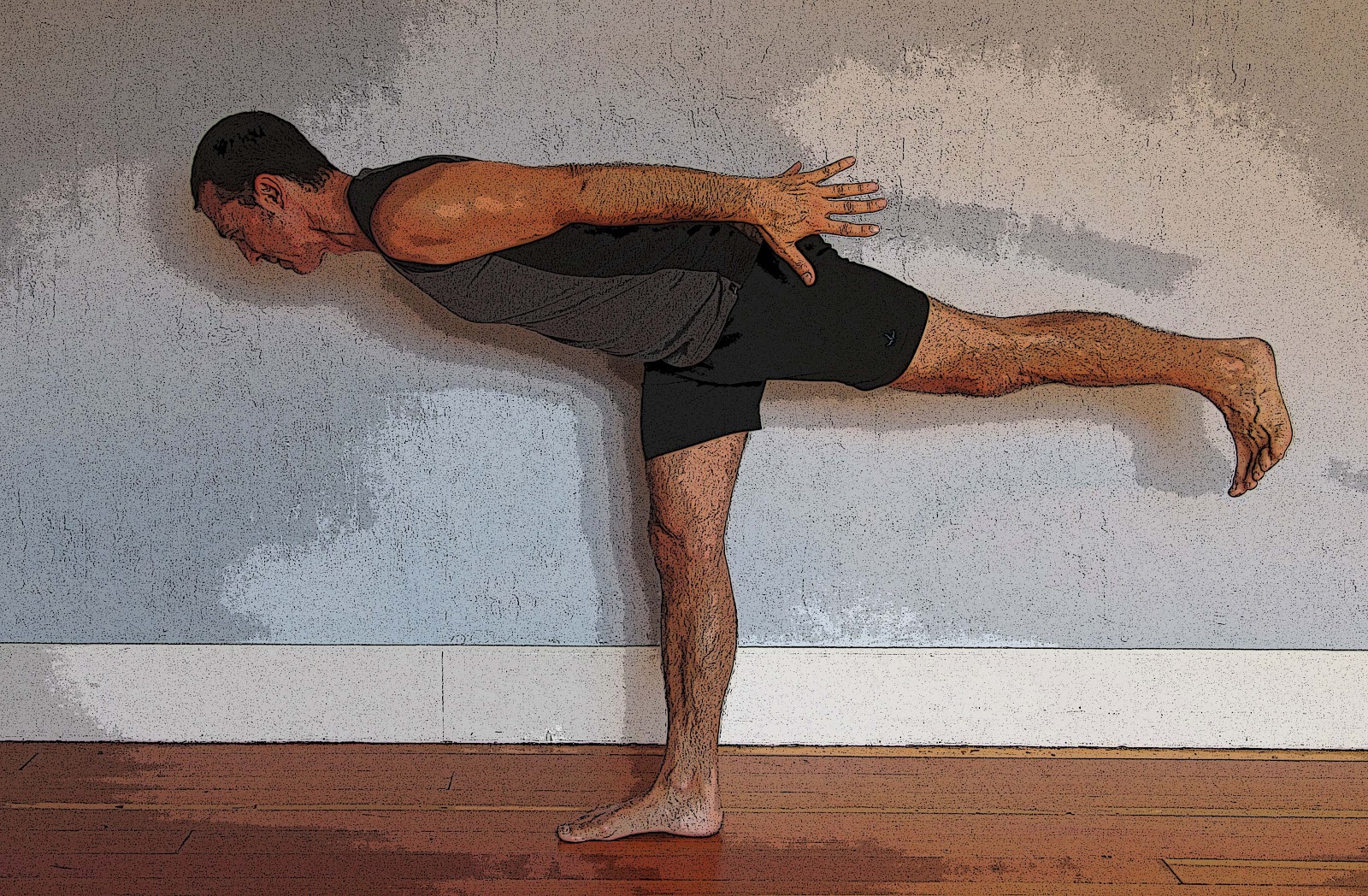
Featured Pose: Warrior 3 (Full)

by Baxter and Nina
Warrior 3 is the third pose in our upper body strengthening series because this pose provides unique upper body strengthening with no weight bearing on your hands. Last week, we featured the wall version of this pose (see Warrior 3 (Wall Version)), which makes it accessible to almost everyone. This week, we’re featuring the full pose. In the full pose, your back body muscles work more than when you’re at the wall, so the spinal extenders in your back and neck are strengthened even more.

As we said last week, Warrior 3 is unique in that in this pose you keep your torso and one leg parallel with the floor. In this position, gravity challenges you to keep yourself upright instead of folding over your front leg. All the musculature on the back of your body has to work actively to keep you in this position, including your hamstrings and buttocks along with all the spinal muscles up to the base of your neck. This week, we’re introducing three different arm variations for the pose, moving from the easiest to balance in to the most difficult. Each arm position strengthens different upper body muscles.

In Variation 1, with the arms back alongside the torso (a kind of Downward Flying Super Hero pose), the muscles you use to take your arms into extension (behind your back, as in Camel pose) are activated. These include the back part of your deltoids, your triceps muscles, and your lattissimus dorsi, as well as the muscles between your shoulder blades that help bring your shoulder blades close together. This variation provides a rare opportunity to strengthen muscles that don’t get much of a workout in your daily life, and it is also the easiest version to balance in.

In Variation 2, with your arms out to the sides (it’s a plane!), your balance is challenged more than in Version 1, therefore your back body muscles get a more intense work out. With your arms out the your sides, you continue to use the backs of your deltoids, but you also activate the muscles between your shoulder blades even more (middle trapezius, rhomboids, etc.).

In Variation 3, the most challenging version to balance in, the fronts of your deltoid muscles, some of your rotator cuff muscles, and your shoulder blade stablizers are strengthened as keep you keep your arms overhead. Because your arms and upper body are resisting the downward pull of gravity, the trapezius, anterior and posterior deltoid, and serratus anterior muscles that are strengthened in the wall version get a more intense workout in the version away from the wall.

Of course, as a bonus, all three versions of Warrior 3 are also excellent for improving balance and for general strengthening of your standing leg and for strengthening the back leg muscles of your raised leg, including your hamstring muscles, which can become overstretched from certain other yoga poses.

Instructions:

Variation 1: Start by moving Warrior 1 pose on your right side (with your right foot forward). From there, bring your hands to your hips. Now tip your torso forward about 45 degrees over your hip joint and come onto the ball of your back foot. On an exhalation, straighten your right leg as you gently propel yourself forward to balance over it with your torso and back leg parallel with the floor. Try to keep both hips even with the floor. Once you have your balance established, bring your arms along side your body with the palms facing each other.
The position of the head of your head should be slightly turned up to face forward (as shown in the photo). This is easiest head position for balance. However, if this is too hard on your neck, try keeping your head aligned with the rest of the spine, with the crown facing forward. Stay in the pose for a couple of breaths, and work your way up to 30 seconds to a minute in the pose.

To come out of the pose, bend your right knee slightly, and bring your raised foot down to floor. Then swing your arms up into Warrior 1 pose, and release from there. Repeat on the left side.

Variation 2: For Variation 2, come into it the same way as version 1, with your hands on your hips. When you have your balance established, bring your arms out the sides, with your palms facing down.
Stay in the pose for a couple of breaths, and work your way up to 30 seconds to a minute in the pose. To come out of the pose, bend your right knee slightly, and bring your raised foot down to floor. Then swing your arms up into Warrior 1 pose, and release from there. Repeat on the left side.

Variation 3:
For Variation 3, come into the same way as Variation 1 except you should leave your arms in Warrior 1 position as you come into full Warrior 3. However, if balance is a big issue, you can start with hands on the hips and then bring your arms forward when your balance is established.
Stay in the pose for a couple of breaths, and work your way up to 30 seconds to a minute in the pose. To come out of the pose, bend your right knee slightly, and bring your raised foot down to floor. Then swing your arms up into Warrior 1 pose, and release from there. Repeat on the left side.

Cautions: If you have low back pain, you may have to drop your lifted leg a bit lower or bend your back knee to reduce the weight stress this pose puts on your lower back (even a micro bend to the back leg can be helpful). If you have arthritis of the neck, you may want to avoid lifting your head to face forward. As always, use common sense. It if hurts to do the pose, come out and ask your teacher for some feedback about what you’ve been doing. If balancing is a big problem and you’re just getting frustrated, return the wall version we featured last week (see Warrior 3 (Wall Version)).

If you’re having a lot of trouble and want to work your way gradually into the pose, you can do the pose at an angle instead of parallel. For more tips, see Nina’s post on Taking on a Yoga Challenge.

Thursday, October 11, 2012

Featured Pose: Warrior 3 (Wall Version)

by Baxter and Nina
Warrior 3 is the third pose in our upper body strengthening series because this pose provides unique upper body strengthening with little or no weight bearing on your hands. Before providing instructions on how to do the full pose (coming soon), which can be quite challenging, we’re providing an alternative using the wall that is accessible to almost everyone.

Warrior 3 is unique in that in this pose you keep your torso, arms, and one leg parallel with the floor. In this position, gravity challenges you to keep yourself upright instead of folding over your front leg. All the musculature on the back of your body has to work actively to keep you in this position, including your hamstrings and buttocks along with all the spinal muscles up to the base of your neck. You are also building strength the arm muscles required to keep your arms overhead (the position known as flexion), including trapezius, anterior and posterior deltoid, serratus anterior.

To enhance the strength building aspect of the pose when you are using your hands on the wall, use the lightest touch possible on the wall so your arms still have to work to hold themselves up. Touching the wall with just your fingertips is the most effective, but you can still gain strength building with your palms lightly on the wall if you prefer full contact with the wall for support, balance, or even just a sense of security.

Instructions: Start by facing a wall, standing about one foot away. Place your hands on the wall shoulder-distance apart, either with palms or your fingertips on the wall. Depending on your hamstring and hip flexibility, your hands should be somewhere between shoulder height and elbow height. Next, bend your knees and push your hips back away from the wall, and, keeping your buttocks over your heels, slowly walk back until your arms and torso form one long line approximately parallel to the floor.
You are now in Half Downward-Facing Dog pose (see Featured Pose: Half Dog Pose at the Wall for photos and detailed instructions of moving into this pose). From here, push your fingertips or palms firmly into the wall as you press your sitting bones away from the wall. Then shift your left foot to the right, at the mid point between your feet, while allowing your hips to shift a little to the left so you are balancing on the left foot. Then swing your right leg up and back, in line with your arms and torso.
Be careful to avoid letting your chest sink toward the floor, because hanging from your shoulder joints puts a lot of strain on them. Instead of feeling a stretch in the shoulders, you want a feeling of even strength around your shoulder joints. So think about lifting your chest up into your shoulder blades, as opposed to dropping your chest down toward the floor and aim for a feeling of completely parallel line (if you are flexible) or an even slope (if your hamstrings are tight).

One you’re in the pose, try lightening the press of your hands on the wall so you can feel the work of your back body’s musculature keeping you in position. With your raised foot slightly pointed, lengthen through your hell away from the wall. Start by staying in the pose for six breaths or so and gradually over time work your way up to 1.5 to 2 minutes.

To come out of the pose, release your right leg down to the floor, bend your knees, and walk in toward the wall. Repeat on left other side.

Cautions: This pose requires a lot of back strength, so if you have lower back issues, you may need to modify the pose by placing your hands higher on the wall or by keeping your lifted leg slightly bent. If you have a hamstring strain, if you feel any strain in the standing leg, bend it slightly so you don’t aggravate your injury.

Thursday, September 27, 2012

Featured Pose: Warrior 1 for Upper Body Strength

by Baxter and Nina
Warrior 1 is the second pose in our upper body strengthening series because, like Warrior 2, Warrior 1 is an accessible pose that is very strengthening for your arms and upper body. Even though you don’t bear weight on your hands or arms, the Warrior 1 arm position entails resisting gravity. Because the arm position is different than Warrior 2, this pose strengthens different muscles, including those that raise your arms forward and up overhead, and all of the small muscles inside the joint that help you stabilize your arms in that position. In addition, because you are taking your arms through the range of motion in forward flexion (forward and up), this pose also helps increase flexibility in the shoulder joint.

Furthermore, as your upper back and chest move into a slight backbend (extension) in Warrior 1, your back muscles are also strengthened, including the muscles around your shoulder blades, your trapezius and serratus anterior, and all the muscles that line your back spine. These are important muscles for keeping your spine healthy and for maintaining good posture. Good posture is essential for healthy aging because it helps keep your spine healthy, supports your respiratory system, and keeps you more mobile.

This pose is accessible even if you have something going on in your shoulders that is challenging because you can control how far you raise your arms. You don’t need to bear weight on your hands, so if you have wrist or hand problems still can do it. And, of course, an added benefit is the pose is very strengthening for the legs as well as the upper body!

Warrior 1 can be challenging to hold (and balance in) for long periods of time, so if you’d like to focus on your upper body rather than your lower body, you can work with your back heel against the wall or try having your feet slightly closer together.

Because we’re focusing on upper body strength for next several weeks, we’re going to give you three different ways to strengthen your body with Warrior 1. Version 1 is the traditional pose, and Versions 2 and 3 use props to help strengthen different muscles in your arms, shoulders and upper body..

Instructions: Starting in Tadasana, step your feet about three feet apart and place your hands on your hips. Spin your right foot out 90 degrees. Then lift your back heel, pivot on the ball of your foot, and spin your back heel back about four or five inches. Next, rotate your hips and chest in the same as your right foot. Don’t force your hips to square with the wall you are facing. Instead, allow your left hip to turn slightly toward your back leg, but square your head and your torso ,from the navel on up,  with your front foot. Maintain a straight strong back leg throughout.

Now, release your arms to your sides and turn your palms to face each other. Keeping your palms facing each other, inhale your arms forward and up. If your shoulders are tight, don’t worry about your arms being exactly vertical. But do keep your arms parallel—don’t try to bring your hands together. On your next exhale, bend your front knee so it is directly over your ankle joint. Do not lean forward or back, but keep your torso directly over your pelvis.
As you breathe in the pose, encourage your outer shoulder blades to lift with your arms, while keeping the upper inner corners of your shoulder blade moving down your back (so the sides of your neck are relaxed and long). Keep your arms active and bring your awareness to your elbows, making sure they are not bent, and reach through both sides of your elbow joints. Stay in the pose for 30 seconds and gradually work up to longer periods of time.

To come out of the pose, inhale and straighten your front leg. Then exhale and release your arms to your sides. Pivoting on the balls of your feet, bring your feet back to neutral as your turn your head and torso to face the long end of your mat.

As you come up, check your back, neck and shoulders for any pain. If you experience pain, reduce the time or change the foot position or not force your arms as high or keep them in a V position if your shoulders are good. Preparing for the other side.

Version 2: With a Block


This version activates the muscles on the inner edges of your arms and increases the activity of your pectoralis muscles so you strengthen more muscles than when you do the pose without the block. Start with the lightest block or prop you have. When pose becomes easier with practice, you can use a heavier prop.
Start by holding the block and follow the instructions for the traditional version of Warrior 1. Before you raise your arms forward and up, place the block between your hands on the widest side. Keeping your arms straight, press firmly into the block with your hands without bending your wrists or hands. As you inhale, take your arms forward and over head, and as you exhale, bend the front knee. If you have tight shoulders you may not be able to bring your arms to vertical, so take them to a comfortable height.

Version 3: With a Strap

This version activates the muscles on the outer surfaces of yours arms and some of your side chest muscles that get extra strengthening.
Before you begin, make a loop with your strap that is sized so when put your arms through and  push your arms against the strap, your arms are kept parallel. Place the strap about two inches below your elbows on the fat part of your forearms (you’ll may have to experiment to find the right position for your head). Note from Nina: yes, yes, I realize the photograph shows the strap just above the elbows, but that seems to work for Baxter. I definitely need the strap higher toward my hands, as otherwise my head gets trapped.

Follow the instructions for the traditional version of Warrior 1. As you raise your arms forward and up, press outward against the strap on your arms as you also focus your awareness on keeping your elbows straight.

Cautions: If you have high blood pressure or cardiovascular problems, we recommend that you do not to stay in the pose for long periods of time. Try doing the pose dynamically instead, moving in and out of the pose with your breath (see Warrior 1 and Warrior 2 Dynamic Vinyasas), which will still strengthen your arms and upper body. When you use the block or strap, honor any sensations of pain in your shoulder joint. Keep the sides of your neck relaxed, and modify your arm position to see if that makes the pain subside. If pain persists, come out of the pose, and ask a teacher to check your alignment.

Thursday, September 20, 2012

Featured Pose: Warrior 2 for Upper Body Strength

by Baxter and Nina

Warrior 2 is the first pose in our upper body strengthening series because it is a very easy and accessible pose that is very strengthening for your arms and upper body. Even though you don’t bear weight on your hands or arms, the arm position entails resisting gravity. This strengthens the muscles that lift your arms to your sides and all of the small muscles inside the joint that help you stabilize your arms at the shoulder joint, including the deltoid and supraspinatus, which are important for maintaining the health of those joints. In addition the pose provides equal strengthening of both your upper back, around the shoulder blades, and your chest, around the collar bones, as you build strength in your upper trapezius. And of course an added benefit is that this  pose is very strengthening for the legs as well as the upper body!

This pose is accessible even if you have something going on in your shoulders that is challenging because it doesn’t require full range of motion in the shoulder joints. And you don’t need to bear weight on your hands, so if you have wrist or hand problems you can still can do the pose.

Because we’re focusing on upper body strength for next several weeks, we’re going to give you three different ways to strengthen your body with Warrior 2. Version 1 is the traditional pose, and Versions 2 and 3 use a slightly different arm position.

Instructions: Starting in Tadasana, step your feet wide apart. Turn your right foot out 90 degrees, then, pivoting on the ball of your back foot, shift your left heel back an inch or two to your left so the foot is slightly turned in.

Next, inhale and raise your arms up so they are parallel to the floor, with your palms facing down toward the floor. Keep your shoulder blades relaxed and moving down your back (not sliding up toward your ears) as you raise your arms. Then, on an exhalation, bend your right knee directly over your right ankle while keeping your torso centered over your pelvis (not leaning over your front leg). Allow your hips to rotate slightly toward your right knee but rotate your chest away from your right knee so your chest faces directly forward. Finally, allow your head and neck to turn so you gaze over your right hand.
Once you are in the pose, use your eyes to check both arms to make sure they are in an even line with the tops of your shoulders, that they are neither too high or low, and that they are parallel with the floor.
Because your purpose in doing Warrior 2 this time is to develop strength in your upper body, you should keep your arms out to your sides for a decent amount of time. Start with 30 seconds and work your way up to 1 to 2 minutes over time, gradually building up endurance. Of course if you’re very fatigued or shaking, come out earlier. Notice that the longer you hold your arms up, the more you unconsciously will slide your shoulder blades up toward your ears. If this happens, consciously move relax your shoulder blades back down your back.

To come out of the pose, exhale and release your arms. Then straight your knee, turn your feet to a parallel position, and switch to the other side:

Version 2: Palms turned up


Because of the external rotation in your shoulder joint required to turn your palms up, this variation allows you to strengthen areas that aren’t strengthened with the first version With your palms up you activate a different portion of your deltoid muscles (front portion) and other muscles deeper in your shoulder joint. You could do Version 2 of the pose immediately after doing Version 1 or you could alternate different arm positions on different days. activates a different portion of your deltoid muscles and activates other muscles deeper in the shoulder joint.

For this version, follow the instructions for Version 1. When it comes time to raise your arms, start by spinning from your upper arms to turn your palms to face front. Then as your raise your arms, keep spinning form your upper arms to turn your palms up toward the ceiling.

Version 3: Holding blocks
This version strengthens the same muscles as version 2, but provides increased strength building because you are holding a weight. You can use yoga blocks, same-weight books, or even bags of rice or beans. However, we recommend building up your strength practicing Versions 1 and 2 before trying Versions 3. We also recommend that you start off with lightest weight possible, such as foam blocks, and work up to heavier weights over time, such as cork or wooden blocks.

For this version, start by holding the props and then follow the instructions for Version 1. As you lift your arms, rotate your upper arm bones so as you arms come out to the sides, the blocks are resting on your upturned palms.

Because of the additional weight, you may feel the additional work, and you may need to reduce the time you stay in the pose! If you become fatigued or shaky, release your arms. Gradually, over time, increase your time in the pose to up to 2 minutes.

Cautions: In general, Warrior 2 is a very safe pose. However, if you experience pain in your shoulder joints or neck, come out of the pose and get some advice from a yoga teacher about your alignment. If you have a history of rotator cuff injury or dislocated shoulder, approach the pose carefully, especially Version 3.


Thursday, September 13, 2012

Upcoming Featured Poses: Upper Body Strength and Flexibility!

by Nina (with Baxter)

Baxter and I have been excitedly planning (and photographing) the next group of poses we’re going to feature on our blog. Inspired by the popularity of my post Building Upper Body Strength the Easy Way, we decided to focus on the upper body for the next several months. We’ll be presenting several basic, easily accessible poses, all with several modifications, that will help you both build your upper body strength while you increase flexibility in your arms, shoulders, chest, and upper back.

Before getting started with the individual poses, we thought we’d take a moment to say something about why upper body strength and flexibility is so important for healthy aging.

With our current shift to more sedentary work styles, for many of us, our upper bodies are typically underused. Because we’re no longer carrying, lifting, and reaching on a regular basis, our upper bodies are not at their optimal levels of strength and function. And even those of us who exercise regularly by walking, running, or cycling, can become imbalanced due to neglecting our upper bodies.

I think that it’s important to most if not all of us that we maintain our independence as we age. For the elderly, upper body weakness has a significant effect on everyday activities, including the most basic ones, such as getting out of a chair, taking care of your home, and carrying your groceries. We also need to work on upper body flexibility, as people who are tight in upper back, shoulder and chest areas can have difficulty taking items off shelves or even dressing themselves.

Working your upper body also helps optimize your circulatory system, keep the connective tissue around your nerves mobile, and facilitate communication between your upper body and your brain, all of which will contribute to keeping your body healthier as you age.  

So stay tuned! Hmmm, what is Baxter doing with that block?

Wednesday, August 1, 2012

Building Upper Body Strength the Easy Way


by Nina

It’s only natural, I guess, that when you start blogging about yoga, your friends are going to ask for your advice, even when you’re on vacation. Luckily for me, I love helping my friends and truly enjoy giving them short private lessons, and seeing their eyes light up when they realize there are some easy yoga solutions to their problems in one of my ideas of FUN.

This time my friend Carol asked me about her right shoulder and wrist, the ones she over-uses when she spends so much time in front of the computer moving her mouse around. She was under the impression that to protect her shoulder and wrist she should not use them very much, even when she was doing yoga. To baby them, in other words. I assured her that, to the contrary, to protect her shoulder and wrist she should be both strengthening and stretching her shoulders, arms, wrists, and hands. Then I gave her a quick private lesson to show her some easy poses she could do on a regular basis.

For her wrists, I showed her the wrist flossing sequence (see Featured Sequence: Wrist Flossing) that is so helpful for preventing carpal tunnel syndrome and other wrists problems. For stretching her shoulders, I showed her a passive backbend over a blanket roll, with her arms overhead and straight, using a strap around her upper arms to make it easier to stay in the pose for around three minutes. I also taught her the doorknob version of Upward Plank pose (Purvottanasana) because she could easily do this in her work place and it’s a nice counter-pose to sitting hunched in front of a computer (see Upward Plank variations). Of course there are many other shoulder stretches, many of which we’ve been covering in our office yoga series (Arm Circles, Eagle pose Arms, Cow-Face pose Arms, etc.).

But what about building upper body strength? I assured her that, no, she didn’t have to do handstands or arm balances, and there were many easy yoga poses that help build upper body strength. Then I quickly ran through a lot of suggestions for her that I thought I share with you today. Hopefully, in the near future, we’ll be able to explore some of these poses in greater depth.

Any pose where you put weight on your arms builds upper body strength, including Cat pose, Downward-Facing Dog, Upward-Facing Dog, Plank pose, Sideways Plank pose (Vasithasana), Upward Plank pose (Purvottanasana), and so on. If you are worried about putting weight on your wrists, you can use a wedge to change the angle of your wrists, do some of the poses with your forearms on the floor instead of just your hands (for example Downward-Facing Dog with forearms on the floor). You can even do Upward Plank pose standing a few feet away from the wall, with one hand on the wall, your outside leg in Tree pose, and your second out to the side or overhead (I swear, I will take a photo of this one of these days). One of my favorite upper body strengtheners, which I learned from yoga teacher Julie Gudmestad, is to move back and forth, several times, between Downward-Facing Dog and Plank pose.
Plank pose
Also, any pose where you hold your arms up or out to the side builds upper body strength, including Warrior 1, 2, and 3, Tree pose, Triangle pose, Extended Side Angle pose, Half Moon pose, and so on. Do you doubt me? Try keeping your arms in position instead of releasing them as you change from the first side to the second side of Warrior 2 (or any other pose). I bet you’ll find it’s harder than you expected.

There are so many possibilities that I once taught an entire workshop on the subject. Here is the mini practice I sent those students home with:

1. Cat pose
2. Downward-Facing Dog pose
3. Standing Forward Bend
4. Two Sun Salutations with Plank instead of Chaturanga
5. Sideways Plank pose (Vashithasana)
6. Upward Plank pose (Purvottanasana)
7. Child's pose

I hope this inspires you to incorporate some upper body strengthening into your home practice!
 

Sample text

Sample Text

Sample Text