Pages

Labels

12th anniversary 21st Amendment Monk's Blood Abbaye De Saint Bon Chien abhyasa abuse abyss active vs. passive poses acute pain agility agitated depression ahimsa Al-Aksir alasya ale alesmith alignment Allagash anatomy Anchor Brewing Anchor Brewing Company anchor steam Anchor Steam Brewing and moderation Andrea Gilats Angel's Share anger ankle circles ankle injuries ankle joint ankle problems ankle sprains anti-aging solution anxiety aparigraha appetite arm pain arm strength arms arthralgia arthritis arthritis (menopause) arthritis of shoulder joint atrial fibrillation avery avery maharaja award winning beer store ayurveda B.K. Bose baba back care back extensor muscles back pain balance Ballast Point baltic thunder bandhas bandwagon of healthy eating baroreceptors basque cider Baxter Baxter Bell bay area beer beer beer advocate beer castro beer club beer club san francisco beer list Beer of the Month beer of the month club beer pong beer shop san francisco beer store Belgian beer belgian beer glasses belgian beer san francisco Belgium. Japanese best beer store in the world BFM Bhagavad Gita Bhramari Bikram Choudhury biological clock Birra Troll Birrifio bitches brew Bittersweet Lenny black butte black lager blood lactate blood pressure body image bone strength Bonnie Maeda bottle bag bourbon Brad Gibson brain strength Brasserie Caracole breath breath practices Brettanomyces Beer Brewing Bridge pose Bridget Frederick Bruery Coton Bruery Mischief Bruery Saison De Lente bruising Brussels Bruton beer bursitis bypass surgery California beer Callifornia beer caloric restriction Cantillon cantillon san francisco Carol Krucoff cascade apricot cascade sang rouge cask strength sake Castro Cat pose Cat-Cow pose cataracts central nervous system cervical nerves Chair Cat pose Chair Downward-Facing Dog pose Chair Purvottansana chair yoga chair yoga sequence challenging pose charlie papazian chatoe rogue cheese Child's pose children Chimay chimay san francisco chocolate indulgence chondromalacia christmas beer chronic illness chronic inflammation chronic pain chronic stress cognitive decline cognitive health collapsed lung commenting comments community community yoga compassion compression of joints connective tissue conscious relaxation contacting writers contentment cortisol counter-poses Cow pose craft beer craft beer san francisco craft beer store craft brew creaky knees Cucapa Barley wine Cuvee de Tomme Cuvee des Champions Damnation dave hauslein david hausein David Hauslein Dayna Macy De Dolle De Proef De Ranke Dead Guy Ale Decadence Pomegranite Saison Decadent Evil degenerative disc disease dementia dental disease depression Depuceleuse san francisco DFH Faithful Ale DFH Twenty dharana dhyana dhyanam diabetes diet digestion digestive disorders digestive system dogfish head Dogfish Head Theobroma Dolphin pose dominus vibiscum doshas double ipa Downward-Facing Dog pose Downward-Facing Dog pose (variations) drake's denogginizer Drie Fontinen duck feet Eagle pose Easy Inverted Pose eating habits eating healthy Einbecker El Camino (un) real emotional wellbeing endorphins endurance training enteric brain equanimity eric's ale European Society of Cardiology exercise extensor muscles eye floaters eye problems facebook beer Fantome fatigue feet felt real happiness fifty fifty brewing company Firestone Walker first growth first trimester fizzy yoga Flanders flat feet Flemish Primitive flemish sour ale flexibility Food pyramid guide forehead skin forward bends fred echardt front body frozen shoulder full sail topsail fun gait Gandhi ganglion cysts Garudasana genetics Georg Feuerstein George Gale ginjo Gonzo goose island goose island san francisco Goouden Carolus gouden carolus Grand Cru greed grief grow your own Gueuze gueuze girardin Haandbryggeriet hakutsuru Halasana (supported) hands Handstand Hanssens lambic happiness hard cider head position head rush headaches health care professionals healthy aging healthy eating Healthy Eating Ideas healthy spirits healthy spirits Mikkeller 1000 IBU healthy spirits san francisco healthy spirits. Deschutes Jubel Ale 2010 healthy spirits. san francisco healthy spirits. san francisco beer healthy spriits healthy style of eating heart problems Hedonist Beer Jive herbs hernias high blood pressure himsa Hinduism hip arthritis hip dysplasia hip replacements history of yoga Hitachino Nest Hitachino XH hoarding home brew home practice home yoga practice hop wallop Howe Sound Hugh Malone hummus hypertension hypotension ida immune system inflammation inguinal hernias injuries insomnia Inverted Lake pose Irritable Bowel Syndrome Jalandara Bandha Japanese beer jatharagni jay hinman jizake John John joint health joint pain joint replacement joints Jolly Pumpkin Jon Kabat-Zinn Judith Lasater kampai karma yoga karuna Kausthub Desikachar kidney kleshas knee alignment knee joint knee pain knee replacement Koningshoeven Krishnamacharya Krishnmacharya kundalini lactic acid lager Lambic large women leg cramps leg length discrepancy (LLD) Legs Up the Wall pose life coaching Life Coaching Executives Life coaching problems ligaments lips of faith longevity Lost Abbey Lost Abbey Brewing Company low back low back pain low blood pressure Luciernaga Lucifer lying male hormones male menopause malnutrition Man Bites Downward-Facing Dog marijuana marin brewing barrel aged old dipsea massage medical advice medical conditions (informing teacher of) medical conditions (yoga for) meditation Melina Meza Melitta Rorty men menopause mental health Mephistopholes micro brew micro-brew middle-eastern Midnight Sessions Lager Midnight sun brewing midnight sun hop dog midnight sun san francisco migraines Mikkeller Mikkeller Beer Geek Breakfast Mikkeller Black Mikkeller chipotle porter mind-body connection mindful yoga mindfulness mini office yoga sequence mini yoga practices miracle mission statement mood Morton's Neuroma motivation Mountain pose Multiple Sclerosis Muriel Zimmerman music nadis napa smith nate breed neck anatomy neck pain neuroma neuropsychiatric disorders new arrivals new belgium new releases nigori Nina Zolotow Niroga Institute noble pils nocturnal leg cramps Nogne-O non-hoarding non-violence Norwegian beer nutrient-dense foods oak aged oak aged ale oatmeal stout Odonata Rorie's Ale odonata saison office yoga Old Inventory Barleywine ommegang Ommegeddon oral hygiene Orval osteoarthritis osteopenia osteoporosis Oyster Stout pain pain management parabola partner yoga Paschima Namaskarana Paschimottanasana passive vs. active poses Patricia Walden Paul Grilley peanuts Pearl Jam Pearl Jam Beer pelvis perimenopause pes planus philosophy physio-yoga pigeon toes pingula pinto plantar fascitis Pliny the Elder Pliny the Younger Plow pose (supported) pneumothorax Port Brewing postural control posture Powerful pose practice practice (changing your) prana prana vayu pranayama pratipaksha bhavanam pregnancy private lessons proprioception psoas Puppy pose purusathas Purvottanasana Purvottansansa quadruppel questions R. Sriram Ram Rao rami barqawi Rami's Mommy's range of motion (ROM) rate beer ratebeer real ale Reclined Cobbler's pose red lentils Redemption relaxation Relaxation pose relaxation response religion (and yoga) resistance training resting restless leg syndrome restorative backbend restorative yoga retreats Reverse Prayer pose Richard Rosen Rodenbach barrel 230 Rogue Brewery Russian River Russian River Sanctification sacroiliac joint sacrum sacrum (anatomy of) safety saint somewhere saison Saison Du BUFF sake Salvation samana vayu samaranth san francisco san francisco Beer San Francisco beer store San Francisco Beer Week san francisco bottle shop san francisco craft brew san francisco fantome san francisco odonata santosha Sarah Powers Sarvangasana (supported) satya saucha Savasana scalene muscles scar tissue Schaerbeekse Kriek Schlenkerla Ur-Bock Schneider scientific studies Sculpin sedentary behavior Seedstore seniors sequencing Setu Bandha Shari Ser shochu shoulder blades shoulder joint (arthritis of) shoulder joint replacement shoulders shoulders. sequences Shoulderstand (supported) sierra nevada sierra nevada 30th anniversary Signature Ale sitting-rising sleep smiling soy speedway stout spiritual health spiritual wellness split peas squatting steenbrugge stem cell regeneration stillwater Stone stone brewing company stopping yoga practice store hours beer strength stress stress management stress response Stretching stroke strong cheese styana suffering Sukasana supplements Supplication Supported Child's Pose Supported Forward Bend Supta Badha Konasana surgery sushumna nadi Swiss beer Table pose tabouli Tadasana teacher (choosing) teachers teaching seniors Temptation testosterone Thanksgiving Thanksgiving Day Schedule The abyys san francisco The Bruery Thoracic Outlet Syndrome Thoreau tilting the pelvis timing poses Timothy McCall top sail toronado total knee replacement towards healing and finding the solution transferring transitions trappist trauma trial run coaching session truth tucking the pelvis TV Twilight and Life Coaching ujjayi breath unfiltered sake unibroue Upavista Konasana upper body flexibility upper body strength Upward Plank pose Upward-Facing Plank pose urthel Utkatasana val dieu Valley Brewing Company variety vata vayu vegetarian way vertical epic vestibular system victory Victory at Sea viloma breath vintage beer violence Viparita Karani vyana vayu Warrior 1 Warrior 2 pose Warrior 3 wedge weight loss weight management wild ale wild devil will power William Broad workshops wrist problems wrists wu tang clan xyauyu yamas Yin Yoga yoga history Yoga Journal conference yoga nidra yoga philosophy yoga sutras yoga therapy yogic breathing yogic phases of life yulesmith summer
Showing posts with label anatomy. Show all posts

Tuesday, June 25, 2013

Tucking and Tilting the Pelvis

by Baxter

We recently received an inquiry about positioning the pelvis in yoga poses that I thought it worth addressing in a general, full-length post. Let’s start with the question:

Dear YFHA Staff,

The phrases "Tuck in and Tuck out" are very commonly used by several of my teachers. I get so confused listening to those words that these days the minute I hear anything close to "Tuck" my meditative yoga practice goes for a ride. What are the teachers referring to when they use those words? Are they alluding to the movement of sacrum? For eg: in Bridge pose and other supine poses, do you draw the sacrum in (I guess the word is Tuck in) or do you draw it out? Can't we just keep the sacrum in neutral position and still get the benefits of the supine poses?


Yes, dear reader, there is a lot of talk about “tucking” the pelvis these days in the yoga world! Although I don’t hear or use the same exact phraseology as you teachers are using, I think I have a sense of what they are going for. I might suggest the terms “tipping” and “tucking” of the pelvis, as a whole, for what is being suggested. In anatomical terms, the action can take place relative to the top of the upper leg bone, the femur bone.

When you “tip” the pelvis, this means you are rolling it forward and down over the head of the femur, in what is referred to in anatomical circles as anteversion or flexion at the hip joint. This happens to some extent in forward bending poses, like Uttanasana (Standing Forward Bend), when we roll the hips forward and down to initiate the forward bend.This movement also encourages the forward rounding of the lumbar vertebrae due to the effect of gravity, known as flexion of the lumbar spine, in the specific situation of Uttanasana. Yet we are also sometimes encouraged to extend the lower spine, as in a backbend, when entering into some forward bends. In other words, as the pelvis is rolling forward over the thighbones, we simultaneously extend the rest of the spine as in a backbend. This can be a useful suggestion in some lower back injury situations, or if you are focusing on strengthening the extensors of the back body. But it could be just as helpful in some cases, to allow the natural flexion of the lower back in Uttanasana accompany the anteversion of the pelvis.
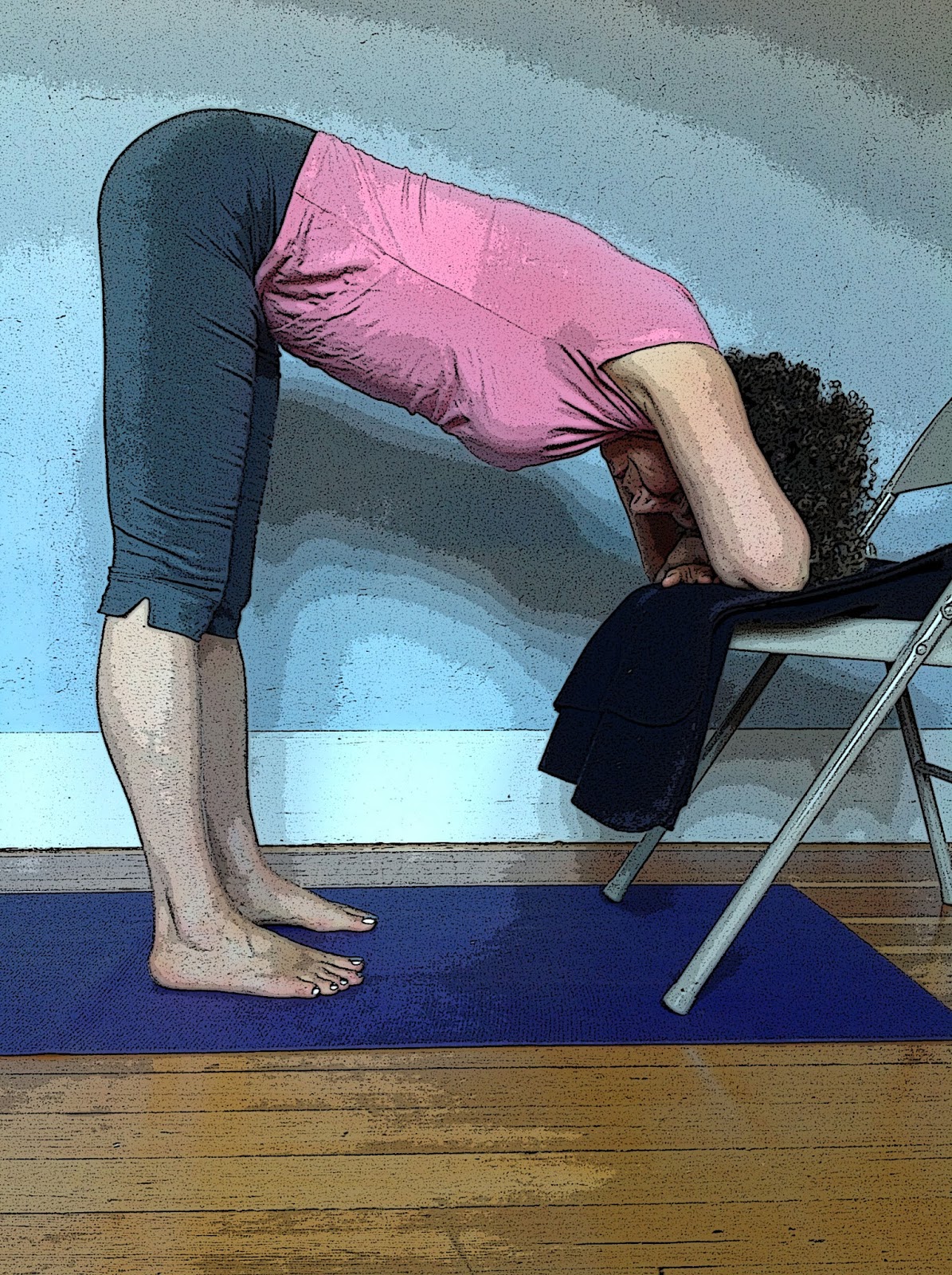
Tipping the Pelvis (Uttanasana)
The other action, which I call “tucking” of the pelvis, is essentially the opposite action, in which the pelvis rolls backwards over the head of the femur bone.  Anatomically, this is called retroversion or extension of the pelvis. It is an essential action, at least to some extent, when we are trying to do some of our back bending poses, like Dhanurasana (Bow pose) or Urdhva Dhanurasana (Upward Bow pose), which require some length and opening at the front of the hip joint to successfully achieve these more advanced backbends. Just like with tipping, the spine may have a natural inclination that accompanies tucking, like some extension of the spine if we are trying to do Upward Bow or Wheel pose. However, if you observe someone standing in Mountain pose, and ask them to exaggerate the tuck, you will notice that the lower spine rounds back, which actually means the vertebrae are tipping forward into flexion. If you then ask the person to tip the pelvis forward, you will see that the lower spine goes into a backbend shape, bowing forward towards the navel. This indicates that the lower spine is going into some extension.
Tucking the Pelvis (Backbend)
Playing with this movement of the pelvis in Mountain pose is a good way to begin to feel these actions and the results at both the hip joint and the lower spine. You might also start to sense if one way feels more typical of how you hold your pelvis relative to you upper leg bones when standing.  If your teacher was suggesting that more tip or tuck would be better for you, see if his or her suggestion actually does what predicted. Be a little skeptical, especially if you are working with a newer teacher. There is a lot of subtlety to this pelvic alignment, and it first it will likely feel a bit strange, even if it ultimately might lead to better posture and lower back alignment. When looking at supine poses, done lying on your back, face up, you will want to do the same experimenting to see what works best for you.

And I have not even mentioned the movements that can happen between the pelvis and the sacrum, known as nutation and counternutation! Shari and I have written some about that elsewhere, so take a re-read of some of those posts (Friday Q&A: Trikonasana, Janu Sirsasana and the Sacrum and Yoga and the Sacrum if you are not familiar with these terms. Judith Lasater, in her book Yoga Body, has a discussion of what happens in regards to these two actions in forward and back bending poses. There is some controversy about how much nutation and counternutation actually take place in adults in yoga poses, but there is a lot of variability in how much “intra-pelvic” movement (between just the two pelvis bones and the sacrum bone) between individuals from my observations. It is always wise to get the opinion of an experienced teacher who can watch your body move in different poses to see where your fall in this regard.

I would also suggest that you directly ask your teacher to stop and demonstrate the actions of tucking so you can get a clearer idea of what he or she is talking about. Sometimes I find that without that clarity, I am just guessing as to what the teacher wants me to experience. And it would also be reasonable to ask why he or she feels this is important to experience. So, ask the how and the why when these sorts of instructions are creating more confusion than clarity, and rock that pelvis on.

Tuesday, February 26, 2013

Holding It All Together, Part 1: Ligaments

by Baxter

As I was prepping for my upcoming workshop this Saturday on Yoga and the Musculoskeletal System out in Brentwood, CA (see Brentwood Yoga Center Workshops for registration information), I decided to look back at my old blog posts to see what I had written regarding tendons and ligaments, two of the main structures we’ll be talking about this weekend. And much to my surprise, I found that I had not yet addressed these basic and vital topics. So today I thought I’d begin a discussion on ligaments, anticipating that I’ll come back to tendons again in the future.

Let’s begin by looking at some basic definitions for these two structures. Both ligaments and tendons are composed of something anatomists call “connective tissue,” which is a collection of tissue types that often serve the function of keeping our different body structures together, and include such diverse tissues as the above tendons and ligaments, as well as fascia, intervertebral discs, cartilage in the ears and nose, cartilage coating the ends of bones and others. Connective tissues, depending on what their function in the body is, will either be more or less elastic by virtue of the proportions of the components that make up connective tissue: collagen and/or elastin fibers, which float in a semi-fluid gel called ground substance. According to Mel Robin, in his book A Physiological Handbook for Teachers of Yogasana, connective tissue works as a mechanical support or binder for other tissues, allows for food and waste from cells to move in and out, acts as a lubricant and is the body’s glue. 

So what then are the structures that ligaments glue together and what are the unique features of ligaments? Ligaments are specialized connective tissue that binds bones to bones. They keep the bones of your joints in close proximity so they don’t dislocate (which sometimes still can happen, in the shoulder joints, for example), and they allow for a certain amount of passive movement in some directions and restrict movement in others.  In fact, restraining movement is one of the main functions of ligaments. They happen to be high in collagen fibers and low in elastin fibers, which makes ligaments strong, but not very flexible. According to David Coulter in his book Anatomy of Hatha Yoga ligaments are:

“...made up of tough, ropey, densely packed inelastic connective tissue fibers, with only a few cells interspersed between large packets of fibers.”

Knee Joint (with ligaments)
Usually, the amount of stretch that can take place in a ligament is very minor, only around 4%, but there are exceptions, such as ligaments in the cervical spine region, which have been found to stretch up to 200%! In contrast, those around the knee joint have very little elastin, so are much more rigid to provide more stability to the joint. This can have relevance for our yoga practice. As an example, deep flexion (forward bending) of the neck as in Shoulderstand will not permanently overstretch the neck ligaments. But deep flexion (bending) of the knee as in Supta Virasana has to be approached cautiously and mindfully so as to not overstretch the supporting ligaments of the knee. If the ligaments are overstretched, they will not return to their original length and will be permanently loose and ineffective in stabilizing the knee. In general, you want to focus on stretching the muscle and not the ligaments in your yoga practice.

Another reason to avoid overstretching or, even worse, tearing a ligament, is that ligaments have a poor blood supply. Due to this poor supply, getting repair cells into an injured ligament and taking away the waste and injured material is more difficult, and healing is therefore slow. Also, ligaments have very few cells—which are the things that have to be stimulated in an injury to produce more fibers and fluid—and this contributes to slow healing as well. 

Those out there who have injured the ligaments at the side of the knee joint, the collateral ligaments, via sports like soccer or football, can attest to the long healing times I am referring to here. When we sprain a ligament, not only do we experience some pain and swelling, but the area also seems looser and more prone to re-injury. A ligament sprain that almost everyone has experienced at one time or another like this is the outer ankle.

It seems that one of the safest ways to stretch your tight muscles, and avoid stretching your supportive yet rigid ligaments, is via moderate intensity, slow, held stretches. Warmer muscles and ligaments seem to do this more healthily then cold ones, so I like to move slowly and mindfully in and out of a position a few times to warm up the tissues, and then follow that up with a more sustained hold. And the good news regarding safe stretching is that our nervous system warns us as we approach the kind of overstretch that could tear our ligaments (and tendons) through pain (which can have a whole range of variety and intensity), trembling or weakness. This is yet another reason to pay close attention to the sensations that arise as you perform your asanas. Also important is the location of the sensations, as those arising in the mid-length of the muscles is much more acceptable than sensations occurring right over joints. You might hang in there a bit longer in the first instance and come out of a stretch promptly in the latter!  

Next time, I’ll discuss tendons, which share some similarities with ligaments, but have some unique functions as well.

Tuesday, June 26, 2012

Getting to Know Your Ankles

by Baxter

Like many joints and areas of your body, if your ankles are healthy and doing their job well, you don’t give the area way down there by your feet much thought. Yet, when an ankle is not healthy or functioning optimally, it can be hard to think of anything else! Once I began to practice yoga asana regularly, I noticed that my teachers would often have us do ankle rolls as a preparation for Thread the Needle pose (a nice hip opener), and I started to become more aware of the area of my ankles. I was not having any acute problems with my ankles at the time, but I began to notice patterns of tension, tightness and lack of coordination that were previously outside my conscious awareness. In retrospect, I now know that this is exactly one of the benefits of yoga:  to make what is not known knowable. 

Like many of my students, I have suffered the occasional ankle sprain in the past. Since this is the most common injury to ankles, I’ll be addressing this in a separate post (coming soon). In addition to these common sprains of the ankle area, the other fairly common problem is that of significant trauma to the area that results in fracture or severe tears of the ligaments and tendons. People with this problem have often undergone some sort of surgery to reconstruct and heal the damage. This surgery can be profoundly beneficial; however, people who have had surgery often complain about persistent aches, limited movement and even weakness. I’ll also talk about this group in a separate post, and propose some strategies for you to work with.

But to start, I’d like to step back for a moment and take a closer look at the ankle joint. This joint connects your foot to your lower leg, and is intimately involved in our ability to stand on two legs as well as our ability to walk and run effectively. The ankle is often thought of as a “hinge” joint, which allows for flexion (like the ankle position in your Downward-Facing Dog pose) and extension (like the front leg ankle in your Triangle pose). These actions are also known as dorsiflexion (the Downward-Facing Dog ankles) and plantar flexion (pointing of the foot).

The bones involved in creating the ankle joint include your lower leg bones (tibia and fibula) meeting the two big bones at the back of your foot (talus and calcaneus). The tibia and fibula extend down and around the sides of the talus and calcaneus, and their distant ends become our inner and outer ankle bones, technically called the medial malleolus (on the inside of the ankle) and the lateral malleolus (on the outside of the ankle bone).

If you look at how far down your two leg bones go, you may notice that the outer one extends farther down toward the foot than the medial one. This will come into play later when we talk about ankle sprains.

The ankle joint is held in close proximity by lots of small, short ligaments that run between the 4 bones. The talus bone, which sits just atop the calcaneus bone (the heel bone), is unique in that it is only attached to the bones around it by ligaments. There are no muscles directly connected to it.


Muscles from the lower and upper leg bones cross by the talus and connect onto the heel bone, such as with the famous Achilles’ tendon, or head further down to connect to other bones in the foot.  When these muscles contract, they create the movements of the ankle joint.
One other tidbit about the flexion and extension of the ankle joint: the joint is more stable the more dorsiflexion there is, as in squats and Downward-Facing Dog pose, and less stable the closer the joint gets to plantar flexion, such as coming up onto our toes in Mountain pose.

Although it would be neat and tidy if those were the only two movements at the ankle, it would limit our movement capabilities. And indeed there are other movements the joint enjoys, such as turning in and out a bit (adduction and abduction), as well a combination of plantar flexion and adduction known as supination, and a combination of dorsiflexion and abduction known as pronation.  Folks who stand on the outer edge of their feet have a bit more supination going on, and those with “flat feet” do a bit more of the pronation action. And often when people come up onto the ball of the foot, the combination of plantar flexion, adduction and supination cause an inversion of the joint. In the opposite scenario, when the ankle is dorsiflexing, abducting and pronating, an eversion is produced. This will become more important when figuring out ankle sprains, which I’ll address in my next post on ankles.
 

Sample text

Sample Text

Sample Text